• When I was a kid, our summer trips to Montana were like stepping into another world—one that smelled of pine, coffee, and a touch of diesel fuel. It might’ve been Lewistown or Great Falls; the two have blurred together in my memory like old film reels left too long in the sun. What I do remember clearly were my grandparents, who somehow embodied everything that was solid, simple, and good about that place and time.

    Grandma always had something cooking. Her kitchen was a refuge where the laws of physics didn’t seem to apply—no matter how many biscuits you ate, the plate was never empty. She could stretch a pot roast farther than I thought possible and still make it taste better the third night than the first.

    Grandpa Ratzlaff was a different kind of magician. He’d retired as the diesel shop foreman for the Great Northern Railroad, but in my eyes, he never really stopped working. You could still see the railroad in his hands—broad, steady, and stained with a lifetime of honest labor. When he wasn’t watching the Yankees, he was down in the basement, surrounded by the sweet smell of sawdust and varnish, carving little wooden horses and wagons from his childhood memories.

    He grew up in that strange and wonderful time when the horse was being traded for the automobile—when the world seemed to shift from muscle to machinery almost overnight. Maybe that’s why he built those little wooden teams and wagons: not to hang onto the past, but to remind himself where he came from. Each carving told a story—a team pulling a load of hay, a buggy on a rutted dirt road, or a kid clinging to the back of a wagon just to catch the breeze.

    Sometimes he’d take me walking along the streams near town, pointing out trout holes or the old rail lines that once carried freight and dreams across Montana. And every now and then, we’d wander into the rail yard itself. The smell of oil and hot steel hung in the air, and the massive locomotives gleamed like mechanical beasts at rest. Once, Grandpa pulled a few strings and got me a ride in the cab of a diesel-electric engine. I can still feel that low, deep rumble under my feet—the kind that seems to shake your bones and rearrange your heartbeat.

    Looking back, I think that day planted a seed in me. The same way Grandpa loved those engines, I fell in love with the sound of a well-tuned motor, the smell of grease, and the satisfaction of making old machinery live again.

    Grandpa lived through the passing of an era—from horses and wagons to roaring engines and endless rails. And maybe, in some small way, I’m still chasing that same transition—trying to understand how the world can move forward so fast, yet somehow still hold onto its heart.

    Because when I think of Montana now, I don’t just see the open plains or the long trains stretching toward the horizon. I see Grandpa at his workbench, carving a memory out of a block of pine, smiling quietly as the shavings fall like snow.

  • My mom had a thing for science. Not the ordinary kind of “I like volcano projects” science—no, she was the full-blown, chemical-engineer-at-Rockwell, safety-goggle-wearing, slide-rule-carrying kind. If something could bubble, fizz, or blow up with sufficient planning and a well-timed “stand back,” she was all in.

    When she became a science teacher at Parks Junior High, she didn’t just teach science—she recruited it. The living room became a staging area for experiments involving everything from dry ice to the mysterious disappearance of every measuring cup in the kitchen. Our house was the only one on the block where you might find a dissected frog cooling next to the leftover meatloaf.

    Mom was fascinated by the sky, too. Not just in a “oh, that’s a pretty moon” way, but in a “let’s drive 1,200 miles to see it get dark for four minutes” kind of way. Her first eclipse was back in 1979, up in Lewistown, Montana, with my dad. She came home sunburned, ecstatic, and convinced she’d glimpsed the secrets of the universe.

    The second eclipse came decades later in Shelby, Idaho, this time with the whole family. By then, Mom had graduated from simple wonder to full-blown planning committee. There were star charts, shadow projections, and at least three contingency maps for “cloud interference.” I half expected NASA to call her for advice.

    She was supposed to see her third one with us, down in Waco, Texas. But she passed away before we could make that trip. And though the grief was heavy, there was no doubt in my mind she’d still find a way to tag along.

    So Dad, the twins, and I packed up the car with an 8-inch telescope, half of our worldly possessions, and a level of optimism that only occurs before you realize how small your trunk really is. After the first night in Arizona, we discovered a universal law of road trips: you can never fit everything back into the car the same way twice. What went in neatly as a masterpiece of geometry now looked like a yard sale gone horribly wrong.

    The second night was spent in Oklahoma, which turned out to be less of a “rest stop” and more of a “weather demonstration.” A tornado touched down not far from our hotel, and lightning split the sky like a fireworks finale. Dad and I stood by the window, grinning like a couple of storm chasers who didn’t know any better. Mom had been born in Tonkawa, Oklahoma—she would’ve loved every minute of that wild, windy night.

    When we finally made it to my sister’s farm in Kansas, there was a peace I hadn’t expected. Years of silence and stubbornness melted away in the easy rhythm of farm chores, kids running barefoot, and shared coffee at sunrise. It felt like Mom was there too, smiling at the reunion she’d probably orchestrated from wherever she was.

    Then we headed for Waco. Somewhere along the way, I told my wife that Austin was “closer than Dallas,” which in my defense sounded reasonable until I had to drive through Texas thunderstorms to go pick her up. The rain came down in sheets, the road vanished under the tires, and I was beginning to think Mom might be conducting another weather experiment from above.

    By the time we returned to Waco, most of the other eclipse chasers had fled to clearer skies. Not us. I’m too cheap for that, and besides, the hotel had a strict “no refunds during celestial events” policy. So we set up the telescope, hooked up a viewing monitor for anyone brave enough to stay, and waited.

    And that’s when John Mather sat down next to us. The John Mather. Nobel Prize winner in physics. The guy who literally studied the origins of the universe. Mom would have been beside herself—probably would’ve quizzed him on the cosmic microwave background between bites of granola. I like to think he felt her presence too, that quiet hum of scientific curiosity in the air.

    The eclipse itself was perfect. Not the weather—just the moment. Clouds parted for those few precious minutes, the world dimmed, the temperature dropped, and for a breathless instant, it felt like Mom had pulled the curtain herself so we wouldn’t miss it.

    Afterward, we packed up (with predictably disastrous results), dropped off Stacie and the twins at the airport, and Dad and I meandered home the long way—two wandering Ratzlaffs in search of meaning and decent diner coffee. Somewhere near the Grand Canyon, we spotted a California condor gliding on the updrafts. Another one of Mom’s favorites.

    We stood there quietly for a long moment, the canyon wind tugging at our hats, the bird circling above like a messenger. And I realized that maybe we hadn’t just gone chasing an eclipse—we’d gone chasing her, too.

    And in a way, we found her.

  • Carolyn Sue Ratzlaff was born in Tonkawa, Oklahoma, where the red dirt seemed to stain everything but your spirit. She came into this world as one of a matching pair—a twin—and from the very beginning she had that spark that makes life brighter for everyone around it.

    Her early years were spent on a dairy farm outside Arkansas City, Kansas. Life there moved to the rhythm of milk buckets clanging, wind rustling through the cottonwoods, and the low hum of contented cows. Mornings came early, often before the sun, and chores didn’t end until long after it had dipped behind the horizon. Carolyn learned quickly that hard work wasn’t a punishment—it was just part of living well.

    She went to a one-room schoolhouse, the kind with a potbelly stove in the corner and a teacher who somehow managed to teach all eight grades at once. Winters meant thawing your hands by the fire before you could hold a pencil, and summers were spent daydreaming out the window about what might lie beyond the prairie.

    Books were her window to that wider world. She loved to read—novels, science books, anything that could take her somewhere new. Her curiosity had no boundaries. That curiosity also drew her toward animals. From dogs and barn cats to lighting bus in a jar  -that included everything from calves to chickens, Carolyn had a natural kindness that every living creature seemed to recognize.

    When she graduated high school, she followed her dreams north to Northern Montana College in Havre. It was a long way from the dairy farm, but the Montana sky felt familiar—wide, open, and full of possibilities. She studied science and poured herself into learning, one of the few women in her field at the time.

    Somewhere between exams and the occasional college dance, she met a young man named Don Ratzlaff. He was the kind of fellow who could fix just about anything with a wrench, a bit of wire, and some creative thinking. They met at a dance, and before long, they were inseparable. After she graduated, they got married—ready to take on the world together with more enthusiasm than money.

    As a young woman she became a 4-H leader, helping young kids learn responsibility and patience through their projects. It was just her nature to encourage others—always teaching, always guiding, always cheering people on quietly in the background.

    Carolyn’s scientific mind and love for understanding how things worked led her to a career as a chemical engineer with Rockwell, back when it was rare for women to be in that line of work. Later, she became a science teacher, bringing that same curiosity and wonder to her students. To her, science wasn’t just formulas—it was the magic of how everything in the universe fit together, from a soap bubble to a solar eclipse.

    She built a life full of learning, family, and quiet adventure. She and Don raised their kids with the same values she’d learned on that Kansas dairy farm—work hard, stay curious, love deeply, and find joy in simple things. Whether she was camping with the family, reading under the shade of a cottonwood, or chasing an eclipse across the country, Carolyn carried that steady spark of wonder with her.

    She left the world better than she found it, not with loud words or grand gestures, but through the lives she touched—the students she inspired, the animals she cared for, and the family she loved more than anything.

    And if you close your eyes, you can almost see her now—standing under that vast Montana sky, wind in her hair, eyes bright with curiosity, still learning, still teaching, still wondering what makes the stars shine.

  • Somewhere north of Barstow, Dad spotted the first junk store sign. I could tell by the way his head tilted that our “quick trip” to Montana was about to turn into an archaeological expedition through America’s rust belt.

    Dad believed junk stores were “full of treasures if you’ve got the eye for it.” I’ve since learned that “treasures” usually meant items that hadn’t been valuable since Eisenhower was president. Still, we’d stop at every dusty building with a hand-painted sign promising “Antiques, Tools, and Curios.” Inside, Dad would dig through bins of bolts and busted gauges while I stared at old bicycles with no wheels. He’d emerge victorious, clutching something oily and mysterious, saying, “You know what this is?” And of course, I never did. That was half the fun for him.

    We were headed north on Interstate 15 to Montana for my first pheasant hunt. I had romantic visions of crisp air, hunting dogs, and well-practiced shots echoing across golden fields. We had none of that. What we did have were two determined Ratzlaffs, one thermos of lukewarm coffee, and a family history of stubborn optimism.

    The motels along the way were chosen by Dad’s tried-and-true method: “If the sign’s still lit, they probably have clean sheets.” One had a shower that squealed like a Model A brake drum and another that offered “continental breakfast,” which turned out to be instant coffee and a Danish still in the wrapper. But to Dad, it was all part of the adventure.

    When we finally rolled into Great Falls, Grandma Ratzlaff greeted us with a hug that would’ve cracked a rib and a dinner that made the whole trip worth it—fried chicken, mashed potatoes, and pie that could make a preacher weep.

    The next day we visited my Aunt and Uncle just off 10th Avenue South—the busiest street in Montana. Now, “busy” is relative. In Montana, that means you might actually have to wait for two cars to pass before backing out of the driveway.

    Then came the big day. The hunt.

    We didn’t have a dog, but Dad figured we could handle it ourselves. “We’ll just walk ’em up,” he said. Which is Montana talk for “we’ll wander aimlessly through the fields until we either find a bird or need a nap.”

    We trudged through miles of stubble and grass, startling everything except pheasants. I managed to flush a grasshopper and trip over a fence post, but the pheasants clearly had better places to be. Dad stayed patient, occasionally muttering something encouraging like, “They’re out here somewhere.”

    And then, miracle of miracles, one pheasant finally took pity on us. It must’ve been feeling sorry for our sorry selves—or maybe it was just on suicide watch—because it flew straight up in front of Dad, hovered politely for a second, and practically waited for him to take the shot. Dad dropped it cleanly.

    That was our only bird of the trip. But you’d have thought we’d just won the national championship of pheasant hunting.

    That night, as we sat around Grandma’s table eating leftovers, Dad said, “Well, we may not have got many, but we sure got one fine one.”

    And he was right. Because trips like that aren’t really about filling the game bag. They’re about the road, the junk stores, the cheap motels, and the laughter that still echoes years later.

    After all, any Ratzlaff can shoot a pheasant—but it takes a special kind of fool to make a grand adventure out of it.

  • It was early July of 1986, and Mammoth, California, looked like it had been hand-painted by Norman Rockwell’s mountain cousin—bright blue sky, green pines, and the faint smell of trout and campfire smoke in the air. Our family had made the annual pilgrimage to meet the Kohnos, our long-time fishing partners and family friends. The Kohnos were as much a part of our fishing trips as tangled lines and burnt marshmallows—thirty years of friendship built on trout, spaghetti, and laughter.

    That year, my sister decided to skip the fishing and go skiing instead. In July. You’d think the snow would have had the good sense to melt by then, but apparently Mammoth hadn’t received the memo. She came back that afternoon looking like an Eskimo who’d lost a boxing match—her face swollen, red, and glowing with a kind of radiant heat usually reserved for stovetops. Sunburn, sun poisoning, or possibly both. Mom and Mrs. Kohno—Jean—clucked and fussed over her, muttering things like “I told you to wear sunscreen,” while they stirred a pot of the best spaghetti dinners ever made north of Italy.

    Meanwhile, Dad, Mr. Kohno (Mitch), and I were up to our knees in the icy streams near Crowley Lake, testing the limits of both our waders and our patience. Mitch was the serious fisherman of the bunch. He believed in stealth, silence, and the sacred art of “not scaring the fish.” Dad, on the other hand, approached fishing the same way he approached car repair—optimistically, creatively, and with the occasional need for bailing wire.

    And then there was me—Wade. A name that seemed to predetermine my fate that day.

    I was carefully balancing on a slippery rock, trying to imitate Mitch’s methodical casting technique, when I discovered just how aptly named I was. One misstep, one slippery rock, and I was fully baptized in the Church of Cold Mountain Streams. Water filled my waders faster than you could say “Rainbow Trout.”

    Mitch’s head whipped around, his face twisted in horror. “You scared the fish!” he hissed.

    Dad, of course, was no help. He was doubled over laughing so hard he could barely breathe. “Guess that’s why we named him Wade!” he sputtered.

    Mitch wasn’t amused, but even he had to crack a smile eventually. Especially after I sloshed out of the creek, shoes squishing, and declared, “At least now I know where the deep spots are.”

    The next day, while Mom and Jean cooked up another legendary dinner and my sister iced her face, Dad decided we needed to make a pit stop—at the Mammoth dump.

    Now, most people go to the dump to leave things behind. Dad went to find them. He said it was “recycling,” but I think it was more of a sport for him—a treasure hunt for the mechanically inclined.

    We’d gotten a flat on one of those bumpy dirt roads leading to the fishing spot, and Mom’s car had one of those ridiculous “donut” spares that limited your speed to something between a brisk walk and a slow crawl. So, there we were, three fishermen prowling the dump in search of a proper tire.

    And wouldn’t you know it? Dad found one. A perfect match, same size and everything—and it had better tread than the other three tires on Mom’s car.

    Mitch just shook his head. “Only Don,” he said, “could come fishing and leave with car parts.”

    By the time we were done, Dad had a spare tire for Mom’s car, a hubcap for my sister’s VW Bug, and a mysterious collection of “miscellaneous parts” that looked suspiciously like future garage clutter.

    We didn’t catch our limit that trip, but it didn’t matter. We’d laughed, we’d fished, we’d feasted, and I’d learned an important life lesson from Dad and Mitch that week:

    Fishing isn’t just about catching fish. It’s about stories, laughter, and sometimes—if you’re lucky—finding exactly what you need in the most unexpected places.

    Even if that place happens to be the Mammoth dump.

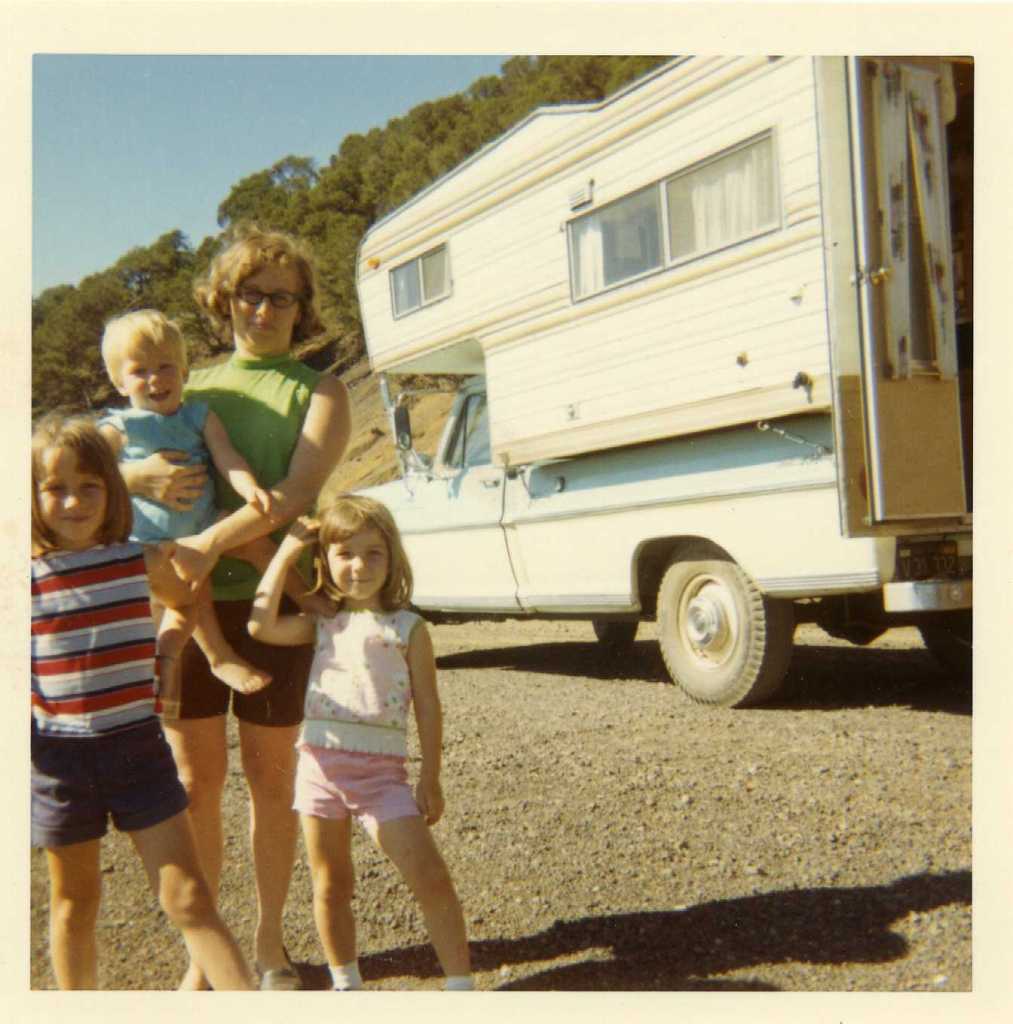
  • Growing up in the 1970s in Orange County was a lot like being in the middle of a Norman Rockwell painting—if Norman had added a Ford F-250 with a camper, a ’65 VW Bug that followed us around like an eager puppy, and a pile of dusty rocks that my parents swore were fascinating specimens.

    My dad, Don, was a member of the Rockwell Rockhounds, which meant two things: (1) he liked rocks, and (2) we, his family, were going to spend a good chunk of our weekends trying to find more of them. Back in those days, big companies had recreation centers, not corporate retreats. Instead of trust-fall exercises, we had swimming pools, craft classes, and potlucks where every casserole was mysteriously topped with cornflakes. It was glorious.

    The camping rig was a sight to behold. The F-250 camper lumbered down the highway like a rhinoceros with indigestion, while the VW Bug zipped along behind us, ready to fetch groceries or serve as emergency transportation if the rhinoceros expired. My sisters, Dana and Corie, were usually in the cab of the truck or stretched out in the back with books, playing games, or arguing over who was not touching whom. Meanwhile, Mom and Dad were up front, navigating us toward exotic locales like Death Valley, the High Sierras, Montana, or, once on a mom-only expedition, all the way to Oklahoma and Kansas.

    Dad had an eye for silver-laced onyx, petrified wood, and fossils, while I had an eye for whether there might be ice cream anywhere within 50 miles. “Look at this beauty!” Dad would say, holding up a rock that looked exactly like the one he’d shown us two hours earlier. Mom, Carolyn, would nod appreciatively, probably already thinking about how much space we had left in the camper before it was technically classified as a quarry.

    Evenings were the best. Around the campfire, Dad would tell stories, Mom would keep us fed, and we kids would roast marshmallows until someone inevitably dropped one in the fire, creating a flaming comet that would streak through camp before sticking to someone’s shoe. We fished in mountain lakes, roasted hot dogs, and fell asleep to the sound of wind in the trees or coyotes yipping in the distance.

    Looking back, the 1970s really were a good time. Times were simpler, though the brakes on the camper occasionally weren’t. Our family trips—whether across the desert, up the Sierras, or out to visit relatives—were less about the destinations and more about being together in that rumbling F-250 and that faithful little VW Bug.

    And though I may not have appreciated the finer points of silver-laced onyx back then, I’ve come to realize those rocks were just souvenirs from the bigger treasures: memories of fishing, traveling, campfires, laughter, and the kind of adventures only Don and Carolyn could dream up.

  • My dad and I once embarked on what we optimistically called a “road trip” and what anyone else would’ve recognized as a cross-country exercise in mutual endurance, caffeine consumption, and bad decision-making. The plan was simple: drive from California to Kansas to visit my sister at her farm outside Wichita. Along the way, we’d scour every town for those elusive Model A parts we were convinced were out there, waiting just for us.

    In our minds, we were like modern-day treasure hunters. In reality, we were two men in a Prius armed with OfferUp, Facebook Marketplace, Craigslist, and an overabundance of wishful thinking.

    Now, you may be wondering why two men chasing Model A parts would choose a Prius for their noble quest. Well, so was I. The Prius was efficient, reliable, and capable of passing every gas station without so much as glancing at the pump—perfect for cross-country travel. Unfortunately, it was also roughly the size of a well-fed Labrador retriever.

    Even before we left, I began to suspect that finding parts wasn’t the real challenge. The real challenge was going to be fitting them in the car. A Model A fender alone is bigger than the entire trunk space of a Prius.

    “Don’t worry,” Dad said as he stuffed another bag behind the seats. “We’ll figure it out.”

    This was the same tone he used years ago when he said, “Don’t worry, I’ve welded the axle back together,” so I knew we were in for an adventure.

    From the moment we crossed the California state line, we were on high alert. We searched for parts the way birdwatchers search for rare species.

    Dad would scroll through OfferUp like a man possessed, muttering things like, “They’ve got a Model A hood in Flagstaff… only two hundred bucks!” Meanwhile, I kept one eye on the road and the other on Facebook Marketplace, hoping to spot a radiator shell before Dad committed us to a 300-mile detour.

    Craigslist was our last resort. It was like panning for gold in a river of spam ads, broken appliances, and people trying to sell used mattresses for “sentimental value.”

    We stopped in every little town along the way, ducking into junkyards and back alleys like a pair of desperate prospectors. Each time, we’d leave empty-handed but convinced the next town held the motherlode.

    By the third state, a painful truth began to sink in: we weren’t going to find the parts we were looking for. And honestly, maybe that was for the best.

    I had visions of us buying a full set of fenders somewhere in Oklahoma and strapping them to the roof of the Prius like some kind of hillbilly aerodynamic experiment. It would’ve looked like a turtle trying to wear a dinner plate as a hat.

    One of the unexpected joys of the trip was the railroad.

    As we drove east, the highway paralleled a set of train tracks for miles and miles. Every so often, a massive freight train would appear alongside us, rumbling along with a kind of steady, unstoppable power that made our Prius feel like a wind-up toy.

    Dad spent hours telling stories of his days working on the Great Northern Railroad.

    “That’s a GE locomotive,” he’d say, pointing like a kid spotting wildlife. “Back when I worked the yard, we’d…” and then he’d launch into a tale of near disasters, eccentric co-workers, and the kind of characters who seem to only exist in railroad towns.

    I listened, half fascinated and half terrified, especially during the stories that ended with, “…and that’s when the whole crew ran for their lives.”

    The trains became a kind of soundtrack to our trip, a reminder that while we were just two guys chasing parts and bad BBQ decisions, the railroad was out there doing real work.

    Somewhere in Arizona, Dad got the bright idea to take a detour onto the original Route 66.

    “You’ve gotta experience the real deal,” he said, his eyes lighting up like a kid on Christmas morning.

    At first, it was great. The old road wound through little towns, past neon signs and weathered gas stations that looked like they hadn’t changed since the 1950s. It was nostalgic and charming—right up until the pavement ended without warning.

    The smooth blacktop gave way to dirt and gravel, and suddenly we were bouncing along like a couple of maracas inside a washing machine.

    “Is this supposed to be part of the experience?” I yelled over the rattling of the dashboard.

    Dad just grinned. “Authentic!” he shouted back.

    Authentic, I decided, was overrated.

    Back on I-40, we found ourselves surrounded by semi-trucks. Not just a few, but an entire migration of them, thundering east and west like a herd of steel bison.

    It felt like we were in a never-ending game of Frogger, except instead of frogs and logs, it was us and 80,000 pounds of angry diesel engines.

    Every time I tried to pass, another truck would appear, looming in the rearview mirror like a scene from a low-budget action movie.

    Dad, of course, was unfazed. “Just tuck in behind ‘em,” he said. “It’s like drafting in NASCAR.”

    I didn’t think NASCAR involved quite this many near-death experiences.

    When we finally crossed into Texas, Dad insisted we stop at Buc-ee’s.

    If you’ve never been to a Buc-ee’s, imagine a gas station, a grocery store, and a small amusement park all rolled into one and staffed entirely by people who think 200 gas pumps is a perfectly reasonable number.

    We grabbed some BBQ that was shockingly good, especially considering it came from a place that also sells lawn chairs, fudge, and inflatable swimming pools.

    Then we filled up the Prius and nearly wept tears of joy at the price. Outside California, gas was so cheap it felt like a practical joke.

    “Should we just stay here?” I asked.

    Dad shook his head. “Nope. Kansas awaits.”

    The last leg of the journey was a blur of wind-swept plains, tiny towns, and endless discussions about which Model A parts we still needed.

    As we pulled into my sister’s farm just outside Wichita, I realized something important: even though we hadn’t found a single part worth buying, the trip had been a success.

    We had stories to tell, BBQ sauce stains to prove it, and a Prius that now smelled faintly of old trains and brisket.

    Dad turned to me as we parked and said, “Well, son, next time we’ll bring a bigger car.”

    I laughed and nodded. Because deep down, I knew there would be a next time. And probably just as few parts.

  • Something I wrote long ago, never shared but always treasured.

    Growing up, I was convinced that the finest vehicle ever to roll off the Ford assembly line wasn’t some fancy sports car or city slicker sedan—it was our two-tone sky-blue-and-white Ford F-250 with a camper mounted on the back like a proud crown. That truck was part transportation, part house, and part adventure magnet. It was also the kind of rig that guzzled gas like a thirsty man drinks lemonade on a hot day, managing a blistering eight miles per gallon—on a downhill with a tailwind.

    It had two twenty-gallon tanks, which meant Dad, Donald, had to fill it up often. Gas station attendants along our cross-country routes knew us by name and probably sent their kids to college on the money we spent fueling that truck.

    Our family consisted of my dad, my mom Carolyn, my sisters Dana (the oldest and, therefore, the boss of everything) and Corie, and me—the youngest, which meant I was everyone’s test subject. Rounding out the crew was Brandy, our Irish Setter, whose life goal seemed to be to out-crazy every other living creature within a hundred-mile radius.

    With that group, adventure wasn’t optional—it was guaranteed.

    Mom loved science the way most folks love warm apple pie. Her specialty? Rocks.

    Everywhere we went across this great country, she collected rocks. Big rocks, small rocks, interestingly shaped rocks, and rocks that, to my young eyes, looked identical to every other rock in the entire desert.

    “See this one?” she’d say, holding up a stone with the same excitement some folks reserve for finding gold. “This is igneous.”

    I would nod solemnly as though I, too, appreciated the finer nuances of geology, while silently wondering if my mom was trying to weigh the truck down to improve traction. By the time we got home, the camper always rode a little lower thanks to her “samples.”

    Dad wasn’t a fan of campgrounds.

    “They’re too crowded,” he’d say, as if civilization itself was a disease to be avoided at all costs.

    So we’d head out into the middle of the desert until there wasn’t a sign of humanity in sight. No cars, no campers, just us, a thousand stars, and the occasional coyote giving us the side-eye.

    At night, the darkness was so complete you couldn’t see your own nose. In the morning, the sun would rise over a horizon so vast it made you feel like a tiny ant in an infinite sandbox.

    It was perfect.

    Of course, it also meant that when one of us kids had to go to the bathroom in the middle of the night, the nearest facilities were roughly two states away.

    Camping in the High Sierras brought its own set of challenges—namely, temperatures cold enough to make a brass monkey seek a sweater.

    One morning, we woke up shivering so hard it sounded like someone was running a maraca band inside the camper.

    Dad, in his infinite wisdom, decided to fire up the oven to take the chill off.

    “Just for a minute,” he said.

    The warmth rolled in like a tropical breeze, and for a few blissful moments, it was downright cozy. Then Mom started muttering about ventilation and carbon monoxide while cracking open every window in the place.

    From that day on, we referred to it as The Great Oven Heating Experiment.

    Brandy, our Irish Setter, was equal parts grace, speed, and unbridled insanity.

    One morning on the plains, she spotted a herd of antelope grazing in the distance. Without so much as a glance back, she launched herself into a dead sprint.

    We hollered, whistled, clapped, and even rattled the dog food bag, but Brandy was locked in full pursuit. The antelope, realizing they were part of an impromptu race, bolted like they’d just been entered in the Kentucky Derby.

    Hours passed.

    Just as we were about to pack up and leave her to a new life on the prairie, Brandy reappeared, staggering toward us. Her tongue hung out like a red flag, her fur was matted, and her expression clearly said, “I nearly caught them, but they cheated.”

    She collapsed into the camper, and we didn’t hear another peep from her until the next day.

    Another unforgettable adventure involved Dad’s decision to bring home a load of railroad ties. These weren’t ordinary railroad ties—they were switching ties, which is to say, they were longer, heavier, and possessed a certain malicious intent.

    He loaded them into the back of the F-250 until the tailgate wouldn’t close. They stuck out so far that passing cars swerved like we were transporting medieval battering rams.

    When we hit a bump in the road, the truck did something that could only be described as a “see-saw maneuver.” The rear end planted firmly while the front wheels floated just high enough to make steering optional.

    “Don’t worry,” Dad said as the horizon tilted at a concerning angle. “I’ve got it under control.”

    His definition of control differed greatly from mine.

    Some of our best memories were made in Panguitch, Utah, where the truck served as our base camp for fishing trips.

    We’d park near a lake so clear you could see the fish mocking you from below the surface. Dad and I would cast lines while Mom scouted for interesting rocks, Dana bossed Corie and me around, and Brandy alternated between chasing birds and napping in the sun.

    The fish didn’t always cooperate, but that didn’t matter. Those trips were about being together, smelling like campfire smoke, and knowing that, at least for a few days, life was wonderfully simple.

    Driving through Montana one morning, we got an unexpected addition to our dinner menu.

    Out of nowhere, a pheasant made the ill-advised decision to fly directly into our windshield.

    It hit with a thud, slid down the glass, and landed in the bed of the truck like a self-delivering entrée.

    “Free dinner!” Dad announced with a grin.

    That night, Mom cooked it up in the camper oven, and while it wasn’t exactly gourmet cuisine, it was definitely the freshest meal we ever had.

    Looking back, growing up with that F-250 was a gift. It wasn’t just a truck—it was a memory-making machine.

    Sure, it guzzled gas at eight miles per gallon, rattled like a loose toolbox, and required a small nation’s GDP to keep running. But it took us places no ordinary vehicle could.

    It was there for Mom’s rock collecting, Brandy’s antelope chases, Dad’s near-death experiments with railroad ties, and countless fishing trips in Utah.

    It carried our family across deserts, mountains, and prairies, leaving behind a trail of laughter, stories, and the occasional dropped rock sample.

    When I close my eyes, I can still see that sky-blue-and-white paint gleaming in the sun, hear the rumble of its engine, and smell the mix of campfire smoke and gasoline.

    That old truck wasn’t just transportation.

    It was the best part of growing up.

  • Today, I come before You seeking Your strength and guidance.
    In my world of systems, networks, and endless tickets,
    I know there will be outages, deadlines, and moments of chaos.
    Help me to face them with a calm heart and a steady mind.

    When systems fail and alarms go off,
    keep me from panic and frustration.
    Give me clarity to see the root of the problem
    and wisdom to guide my team toward solutions.
    Let my words bring calm to those who rely on me,
    even when the situation feels out of control.

    When deadlines loom and projects seem overwhelming,
    help me to prioritize what matters most
    and to approach each task with focus and determination.
    Protect me from burnout, Lord,
    and remind me that rest and renewal are also part of Your design.

    As I work with my team,
    fill our conversations with respect, patience, and understanding.
    Help me to listen more than I speak,
    to support rather than criticize,
    and to lead by example with integrity and humility.

    Bless my hands and mind to work efficiently,
    my spirit to remain patient,
    and my heart to remember that every line of code,
    every answered call, and every resolved ticket
    is ultimately service to others.

    When I feel overwhelmed, remind me that You are my refuge and strength.
    When I feel alone, remind me that You walk beside me.
    And when I succeed, remind me to give You the glory.

    Thank You for giving me the skills and opportunities to serve in this role.
    Guide me through this day with grace and purpose.

    Amen

  • By Wade Ratzlaff

    There are times in every man’s life when he looks at everything he owns, piles it all up, and thinks, “This should probably go in the back of a 1930 Model AA truck and be driven up the coast at a stately 35 miles an hour.”

    Most men, of course, never follow through on that thought.
    I am not most men.

    The move from Fullerton to Santa Barbara seemed simple enough. After all, it’s only a couple of counties away. But when you decide to do it in a truck that was built back when Calvin Coolidge was in office, things get… complicated.

    My 1930 AA stake bed truck has a certain personality. It rattles like a coffee can full of marbles, smells faintly of motor oil and history, and has the aerodynamic grace of a brick with wheels. It’s the sort of vehicle that doesn’t just drive down the road—it announces itself like a freight train pulling into a small town.

    I loaded everything I owned into the back: furniture, boxes, tools, and at least three random items I couldn’t identify but was pretty sure I’d need someday. By the time I was finished, the truck was groaning like an old mule and sitting a good four inches lower in the back.

    I stood there for a moment, admiring my work. It looked like a scene out of The Grapes of Wrath if Steinbeck had included a chapter on busted knuckles and vintage Ford suspension.

    “Good enough,” I muttered. “If it stays in until Santa Barbara, I’ll consider it a win.”

    Most people would use maps, GPS, or at least glance at a road sign before undertaking a long-distance move. I figured, “Why complicate things?”

    My navigation strategy was simple: take surface streets until I hit the 101 freeway in Ventura, then turn north and hope for the best. After all, you can’t get lost if you never really know where you’re going in the first place.

    I decided to leave at 4 a.m., partly to avoid traffic and partly because the fewer witnesses to this ridiculous endeavor, the better. The neighbors already had their suspicions about me, and I didn’t want to confirm anything.

    The first leg of the journey was almost peaceful. The old truck rattled along through the dark, the stake bed creaking under the weight of my worldly possessions. The streetlights flickered by, and I imagined myself as a 1930s trucker on some long-forgotten delivery route, back when five gallons to the mile was considered efficient.

    At five miles per gallon, I quickly became acquainted with nearly every gas station between Fullerton and Ventura. Each stop involved filling both the gas tank and the radiator, a ritual that attracted curious stares from onlookers.

    “Is that thing… safe?” one guy asked, eyeing the truck warily.

    “Define ‘safe,’” I replied, handing over another twenty-dollar bill.

    By the time I finally reached Ventura, the sun had risen, the morning rush had begun, and my confidence had evaporated. Still, there was no turning back now.

    I turned onto the 101 freeway, merged into traffic, and immediately realized this was a horrible mistake.

    You haven’t truly lived until you’ve piloted a fully loaded 1930 stake bed truck at 35 miles an hour on a modern freeway while everyone else flies past you doing 75. The truck rattled so violently I began to suspect some of my internal organs were loosening.

    The steering wheel vibrated in my hands like a live wire, and every passing semi created a wind vortex that shoved me halfway into the next lane. Meanwhile, modern drivers zipped past with expressions that ranged from mild curiosity to outright terror.

    I kept my white-knuckled grip on the wheel and repeated a calming mantra:
    “Stay alive. Stay upright. Don’t let the mattress fly out.”

    At 35 miles an hour and five miles per gallon, progress was… leisurely. My route became a series of evenly spaced gas stations, each one like an oasis in the desert. I’d pull in, climb out with stiff legs, fill the tank, top off the radiator, and check the load in the back to make sure my dresser hadn’t escaped somewhere around Oxnard.

    By mid-morning, I was on a first-name basis with several gas station attendants. One guy even asked, “You moving cross-country or just across the county?”

    “Just up to Santa Barbara,” I said.

    He whistled. “You’re either a genius or completely nuts.”

    “Why not both?” I grinned, then paid for another round of gas.

    Just when I started thinking I might actually pull this off without a hitch, the universe decided to remind me who was really in charge.

    South of Carpinteria, there was a loud BANG followed by a rhythmic flop-flop-flop sound. The truck swerved slightly, and I knew immediately: flat tire.

    I pulled onto the shoulder, which was about six inches wider than the truck itself, and climbed out to assess the damage. Sure enough, the rear tire looked like a sad pancake.

    Changing a tire on a 1930 AA stake bed truck on the side of a freeway is a character-building exercise. It involves equal parts brute strength, creative cursing, and sheer blind faith.

    As cars screamed past at warp speed, I wrestled with the jack, the lug nuts, and my own will to live. Forty sweaty minutes later, I had the spare mounted and my pride only slightly dented.

    The last leg into Santa Barbara felt like the home stretch of an epic quest. The truck rattled, my ears rang, and the smell of hot engine coolant filled the cab, but nothing could dampen my spirits.

    As I rolled into town, I felt a surge of victory. I had made it—no maps, no breakdowns (well, except for the flat tire), and no lost cargo.

    I parked the truck, climbed down on shaky legs, and looked at my faithful old AA.

    “We did it, old friend,” I said, patting the fender. “Against all odds, we did it.”

    Looking back, the move wasn’t just about hauling my belongings from one city to another. It was about the experience—the dawn departure, the endless pit stops, the rattling ride on the freeway, and the small victories along the way.

    Sure, there were moments of terror, exhaustion, and the occasional mechanical mishap. But there was also a strange, wonderful sense of adventure.

    After all, anyone can rent a moving truck and get the job done in a few hours.
    But it takes a certain kind of lunatic to trust a 1930 stake bed truck, a full load of possessions, and sheer stubbornness to get the job done.

    And when I fire up the old AA today, I swear I can still hear the faint rattle of the freeway and smell the ghost of radiator steam mixed with triumph.